
Curious about Snake Plant Care: Everything You Need to Know (2026)
Snake Plant Care: The Complete Guide for a Thriving, Unkillable Plant
If houseplants had a mascot for “I forgot to water this for three weeks and it’s somehow fine,” it would be the snake plant. Ask any plant shop owner which plant they recommend to a first-timer, a chronic over-waterer, or someone who just wants a bit of green in a dark office corner, and you’ll hear the same answer almost every time: snake plant.
But “nearly indestructible” isn’t the same as “impossible to kill.” Snake plants have a very specific set of preferences, and the plants that die aren’t usually neglected — they’re overloved.
This guide walks through everything you need for proper snake plant care: light, the one watering rule that matters more than any other, soil, repotting, propagation, and how to fix the handful of problems that actually show up in real homes.
Whether you’re picking up your first Sansevieria or troubleshooting a plant that’s seen better days, everything below is based on how this plant actually grows — not just what worked for one person’s windowsill.
Snake Plant Overview
Before diving into snake plant care specifics, it helps to understand what this plant actually is and where it comes from — because both explain almost every care rule that follows.
Scientific Name
For decades, the snake plant was known as Sansevieria trifasciata. Following DNA-based reclassification in 2017, botanists folded the entire Sansevieria genus into Dracaena, so the plant’s correct scientific name is now Dracaena trifasciata. Most nurseries, plant tags, and casual conversation still use “Sansevieria” — both names refer to the exact same plant, and nothing about its care changed with the rename.
Origin
Snake plants are native to tropical West Africa, from Nigeria east through the Congo, where they grow in rocky, dry, often shaded understory conditions. That native habitat is the entire reason this plant tolerates low light and drought so well — it evolved to survive exactly those conditions long before it ever ended up on a windowsill.
Growth Rate
Snake plants are slow growers by design. Expect a handful of new leaves per growing season (spring through early fall) rather than the rapid, sprawling growth you’d see from a pothos. Slow growth is normal — it isn’t a sign that something is wrong.
Lifespan
With reasonable care, a snake plant can easily live 5–10 years indoors, and many long-term plant owners report specimens well past that with occasional division and repotting. This is a genuine multi-decade houseplant if you keep the roots healthy.
Toxicity Warning
| ⚠ Toxicity Warning: Keep Away From Pets and Small Children The ASPCA lists snake plants as toxic to both cats and dogs. All parts of the plant contain saponins, a natural compound that irritates the digestive tract if chewed or swallowed. Common symptoms after ingestion include nausea, vomiting, drooling, and diarrhea. Reactions are usually mild because the leaves taste bitter, but contact your veterinarian or the ASPCA Animal Poison Control Center if your pet shows symptoms or has eaten a significant amount. If you have curious cats, dogs, or young children at home, place snake plants on a high shelf or in a room they can’t access. |
Source: ASPCA Animal Poison Control — Toxic and Non-Toxic Plants: Snake Plant: https://www.aspca.org/pet-care/aspca-poison-control/toxic-and-non-toxic-plants/snake-plant
| Trait | Details |
| Scientific Name | Dracaena trifasciata (formerly Sansevieria trifasciata) |
| Common Names | Snake plant, mother-in-law’s tongue, viper’s bowstring hemp |
| Origin | Tropical West Africa (Nigeria to the Congo) |
| Growth Rate | Slow — a few new leaves per growing season |
| Mature Height | 6 inches to over 4 feet, depending on variety |
| Lifespan | 5–10+ years indoors with proper care |
| Toxicity | Toxic to cats and dogs (saponins); keep away from pets |
Snake Plant Light Requirements
Light is the one area where snake plants earn their “unkillable” reputation — but it’s also where a little knowledge goes a long way toward a fuller, healthier plant instead of a merely surviving one.
Ideal Light
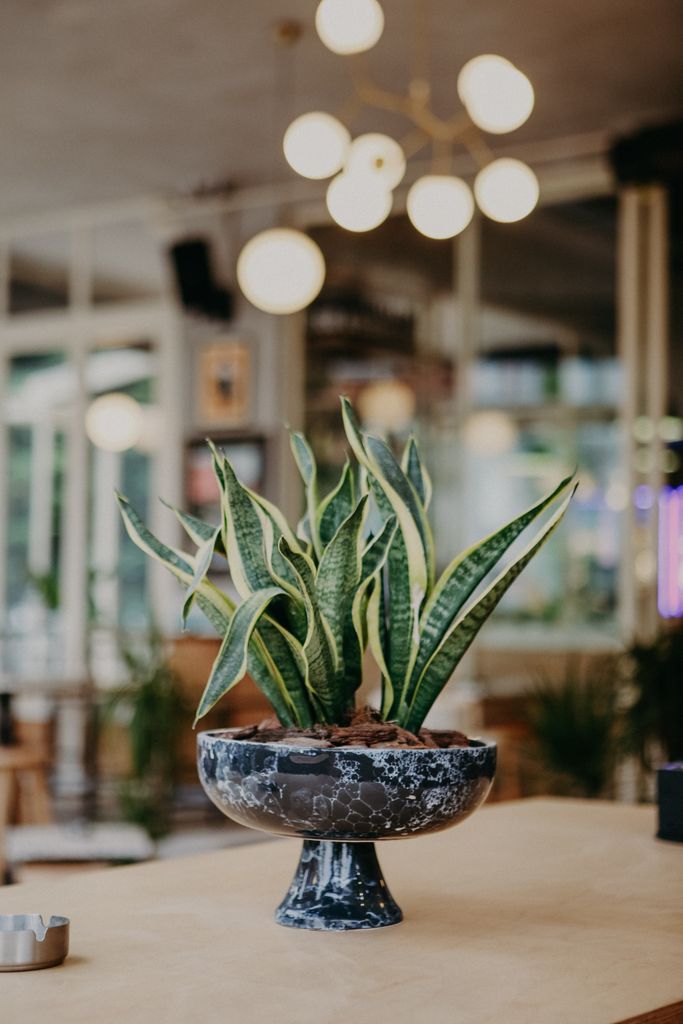
Snake plants do best in bright, indirect light — think a few feet back from a south- or east-facing window. In this kind of light, growth is faster, leaves stay firm and upright, and variegated varieties (the ones with yellow or white edges) hold their coloring best. Some direct morning sun is tolerated well and can even intensify leaf color, but strong afternoon sun through unfiltered glass can scorch leaves.
Low-Light Tolerance
This is the trait that made the snake plant famous. It genuinely tolerates low-light corners, north-facing rooms, and offices with only fluorescent lighting — conditions that would kill most flowering or broad-leafed houseplants within weeks. The tradeoff is growth speed: in low light, expect the plant to grow noticeably slower and to need water far less often, since less light means less water uptake.
Signs of Too Much or Too Little Light
| Light Condition | What You’ll See |
| Too much direct sun | Pale, bleached, or brown scorch patches on leaves facing the window |
| Too little light | Leaves lean or reach toward the light source; new growth is thin, pale, or slow to appear |
| Ideal light | Leaves stay upright, firm, and richly colored; steady (if slow) new growth |
How to Water a Snake Plant (The Most Important Section)
If you read nothing else in this snake plant care guide, read this section. Overwatering is, by a wide margin, the number-one cause of death for snake plants — not neglect, not low light, not the wrong pot. Getting watering right solves almost every other problem before it starts.
The “Dry Out Completely” Rule
Snake plants store water in their thick, fleshy leaves (a trait called succulence), which means they’re built to go long stretches without watering. The rule is simple: let the soil dry out completely — not just the surface, but all the way down to the roots — before you water again.
- Push a finger or a wooden skewer 2–3 inches into the soil; if it comes out with any damp soil clinging to it, wait longer
- When you do water, water thoroughly until it runs from the drainage holes, then let the pot drain completely — never let it sit in standing water
- As a rough starting point, most indoor snake plants need water only every 2–6 weeks, depending on light, pot size, and season
That range is intentionally wide, because “how often” depends entirely on your specific light and humidity — the finger test is far more reliable than any fixed schedule.
Seasonal Watering Adjustments
- Spring and summer (active growth): the plant uses more water and light is typically stronger, so the soil dries faster — check every 1–2 weeks.
- Fall and winter (dormancy): growth slows dramatically and the plant’s water needs drop with it. Many snake plant owners water just once a month, or even less, during winter.
Watering on a fixed weekly schedule regardless of season is one of the fastest ways to overwater a snake plant. Let the soil — not the calendar — decide.
Signs of Overwatering vs. Underwatering
| What You See | Likely Cause |
| Yellowing, mushy, or translucent leaves | Overwatering |
| Soft, collapsing base or a foul smell from the soil | Overwatering (likely root rot — act quickly) |
| Leaves wrinkling, curling, or looking thin/deflated | Underwatering |
| Dry, crispy brown leaf tips | Underwatering or low humidity |
| Soil pulling away from the pot’s edges | Underwatering |
If you’re ever genuinely unsure which direction to correct, underwatering is always the safer mistake — a thirsty snake plant recovers in days, while a rotting one may not recover at all.
Best Soil for Snake Plants
Because overwatering is the biggest risk to this plant, soil that drains fast is non-negotiable. A well-draining, gritty potting mix is what actually protects your snake plant from root rot — arguably even more than your watering habits do.
The easiest approach is a cactus or succulent potting mix straight from the store. If you want to build your own, a reliable ratio is:
- 2 parts standard potting soil
- 1 part coarse sand or perlite (for drainage)
- 1 part small bark chips or pumice (for airflow around the roots)
Avoid dense, moisture-retentive mixes marketed for tropical or fern-type plants — they hold far more water than a snake plant’s roots can handle, and they’re one of the most common reasons a well-intentioned, correctly-watered plant still develops root rot.
Choosing the Right Pot (Why Drainage Is Everything)
Soil solves half the drainage equation; the pot solves the other half. A drainage hole isn’t optional for a snake plant — it’s the difference between water passing through the soil and water pooling at the roots.
- Always choose a pot with at least one drainage hole, and use a saucer to catch runoff rather than letting the pot sit in a sealed cachepot
- Terracotta and unglazed ceramic pots are ideal because the porous material wicks excess moisture out through the sides, adding an extra layer of protection against overwatering
- Choose a pot only slightly larger than the current root ball — an oversized pot holds far more soil (and water) than the roots can use, which keeps the mix wet for longer than it should be
If you love a decorative glazed or plastic pot without drainage, use it as an outer cachepot and keep the plant in its nursery pot (or a terracotta liner) inside it. That way you get the look without sacrificing drainage.
Fertilizing Your Snake Plant (Less Is More)
Snake plants evolved in nutrient-poor, rocky soil, so they simply don’t need — or want — heavy feeding. Over-fertilizing is a genuine risk (it causes salt buildup and burned root tips), so the guidance here is intentionally minimal.
- Feed only during the active growing season (spring through summer), and only once every 4–6 weeks
- Use a balanced, all-purpose houseplant fertilizer diluted to half the strength recommended on the label
- Skip fertilizer entirely during fall and winter, when the plant isn’t actively growing and can’t use the extra nutrients
If in doubt, don’t feed — a snake plant that never gets fertilizer will still grow, just a little more slowly. One that’s over-fertilized can develop crispy, burned leaf tips that won’t reverse.
When and How to Repot a Snake Plant
Snake plants actually prefer being slightly root-bound, so this is not a plant you need to size up every year. Repot only when you notice one of these signs:
- Roots visibly circling the surface of the soil or emerging from the drainage holes
- The pot cracks from root pressure (a common sign with plastic nursery pots on mature plants)
- Water runs straight through without the soil absorbing it, meaning there’s more root than soil left in the pot
- It’s simply been 3–5 years since the last repot
To repot: gently remove the plant, loosen the outer roots by hand, and move it into a pot only one size up (about 2 inches in diameter larger) using fresh, well-draining soil. Spring is the ideal season, since the plant is entering active growth and will recover from the root disturbance fastest. Skip watering for about a week after repotting to let any damaged roots callous over.
How to Propagate Snake Plants (3 Methods)
Few houseplants are as forgiving to propagate as the snake plant, which makes it an easy (and free) way to fill more pots or share with friends. Here are the three most reliable methods.
Water Propagation
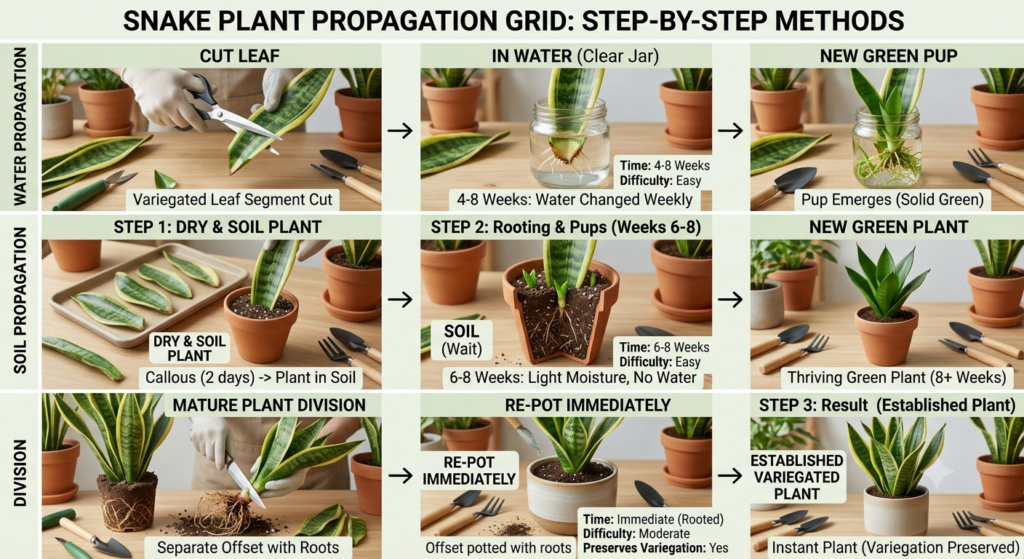
Cut a healthy leaf near the base and place the cut end in a few inches of water, changing the water every week or so. Roots typically appear within 4–8 weeks. Note: leaf cuttings from variegated varieties (like ‘Laurentii’) will usually revert to solid green, since the variegation isn’t preserved through leaf propagation — for variegated plants, use division instead.
Soil Propagation
Cut a leaf into 2–3 inch sections, let each cut end callous over for 24–48 hours (this prevents rot), then insert the calloused end into a well-draining soil mix. Keep the soil lightly moist, not wet, until roots establish — usually 6–8 weeks.
Division
Division is the fastest method and the only one that preserves variegation in patterned varieties, because you’re separating an already-rooted section of the parent plant rather than growing new roots from scratch. Remove the plant from its pot, identify natural separations in the rhizome (the thick underground stem), and use a clean, sharp knife to divide it into sections — each with its own roots and at least one healthy leaf fan. Pot each division separately in fresh, well-draining soil.
| Method | Time to Root | Difficulty | Preserves Variegation? |
| Water Propagation | 4–8 weeks | Easy | No (reverts to green) |
| Soil Propagation | 6–8 weeks | Easy | No (reverts to green) |
| Division | Immediate (already rooted) | Moderate | Yes |
Common Snake Plant Problems (And How to Fix Them)
Because snake plants are so tolerant, when something does go wrong it’s usually one of a small handful of predictable issues. Here’s how to diagnose and fix each one.
Yellow Leaves
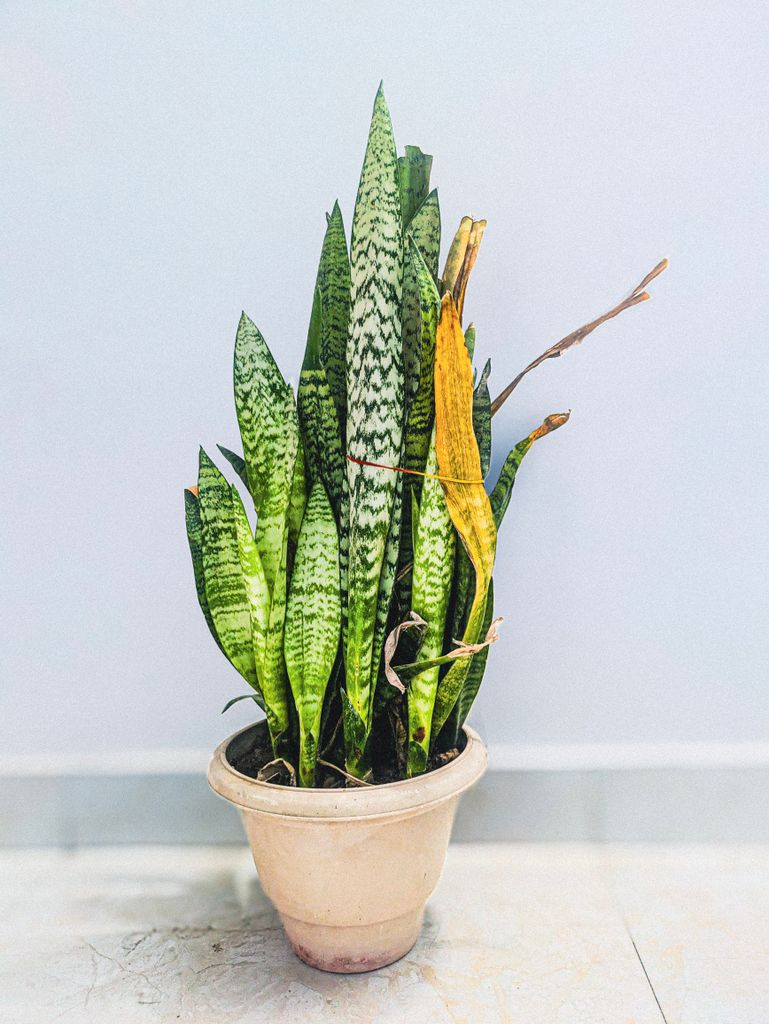
Almost always a sign of overwatering. Check the soil: if it’s wet or has been consistently damp, let it dry out completely before watering again, and consider whether the pot or soil is draining well enough. Isolated yellowing on a single old leaf near the base can simply be natural aging and isn’t a cause for concern.
Brown Tips
Usually caused by underwatering, low humidity, tap water with a high mineral or fluoride content, or fertilizer burn. Trim the browned tips with clean scissors following the natural leaf shape, and check whether watering has been too infrequent or fertilizing too frequent.
Mushy Base (Root Rot)
| ⚠ Act Quickly: Root Rot Signs A soft, mushy, or discolored base combined with a foul odor from the soil is a strong sign of root rot, usually from prolonged overwatering in poorly-draining soil. Remove the plant from its pot immediately, cut away any black or mushy roots and leaf bases with a clean, sharp blade, and let the remaining healthy tissue dry for a day before repotting into fresh, dry, well-draining soil. Hold off on watering for at least a week after treatment, and avoid the pot or soil mix that caused the problem in the first place. |
Drooping Leaves
Snake plants are known for rigid, upright leaves, so drooping is a reliable red flag — most often from overwatering (roots can’t support the leaf when they’re rotting) or, less commonly, from a pot too small to anchor a tall, top-heavy plant. Check the roots first; if they’re healthy, the fix may simply be a heavier or wider pot for better stability.
Best Snake Plant Varieties to Know
“Snake plant” isn’t just one look — the genus includes dramatically different shapes, heights, and colors, all sharing the same easygoing care requirements above.
| Variety | Look | Typical Height |
| Laurentii | Tall, upright leaves with bold yellow edges | 2–4 feet |
| Moonshine | Wide, pale silvery-green leaves; striking solid color | 1.5–2 feet |
| Black Gold | Deep green leaves with thick golden-yellow margins | 2–3 feet |
| Cylindrica | Round, spear-like leaves, often braided | 2–3 feet |
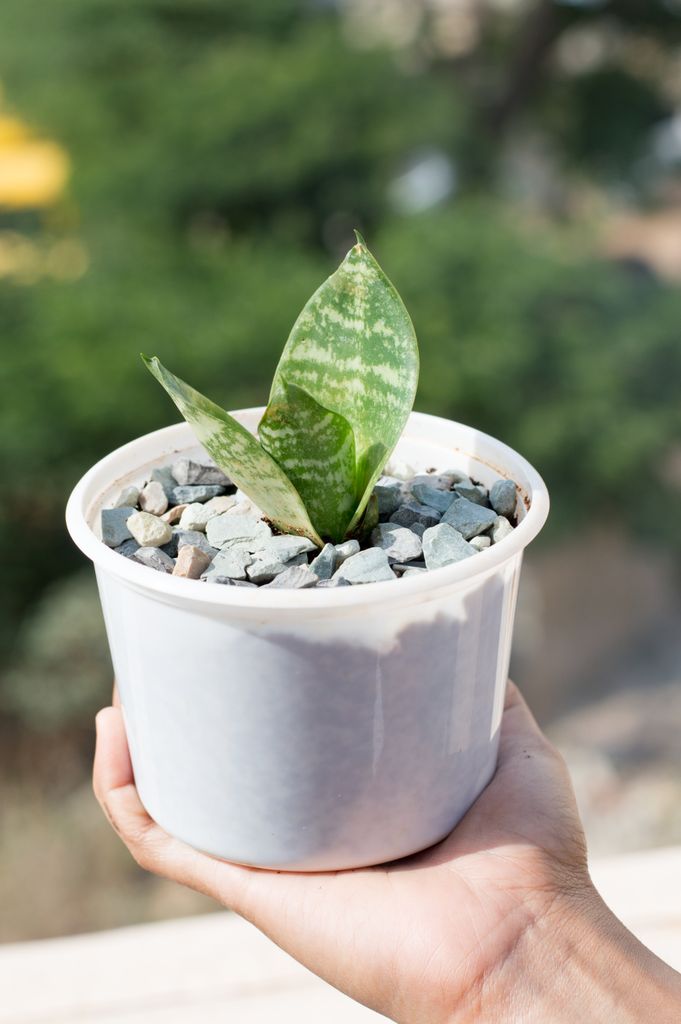
| Hahnii (Bird’s Nest) | Compact rosette form, great for small spaces | 6–8 inches |
| Whitney | Compact rosette with cream and green variegation | 8–12 inches |
FAQ: Snake Plant Care
Final Thoughts: The Plant That Forgives You
Good snake plant care really comes down to one mindset shift: this is a plant that’s far more likely to suffer from too much attention than too little. Give it bright, indirect light where possible, let the soil dry out completely between waterings, plant it in something that drains fast, and leave the fertilizer in the cupboard most of the year.
Do that, and you’ll have a plant that quietly holds down a corner of your home for a decade or more — no fuss, no drama, and very few of the problems that plague fussier houseplants. That’s exactly why it’s earned its reputation as the most recommended beginner plant in the world.
References & Further Reading
- ASPCA Animal Poison Control — Toxic and Non-Toxic Plants: Snake Plant — https://www.aspca.org/pet-care/aspca-poison-control/toxic-and-non-toxic-plants/snake-plant
- New York Botanical Garden — Research Guides: Snake Plant (Dracaena) — https://libguides.nybg.org/snakeplant
- Wikipedia — Dracaena trifasciata (taxonomy and native range) — https://en.wikipedia.org/wiki/Dracaena_trifasciata
- Cornell College of Agriculture and Life Sciences — Saponins (Poisonous Plants Informational Database) — https://poisonousplants.ansci.cornell.edu/toxicagents/saponin.html


One Comment